Look up · dinosaur 511 of 1,425
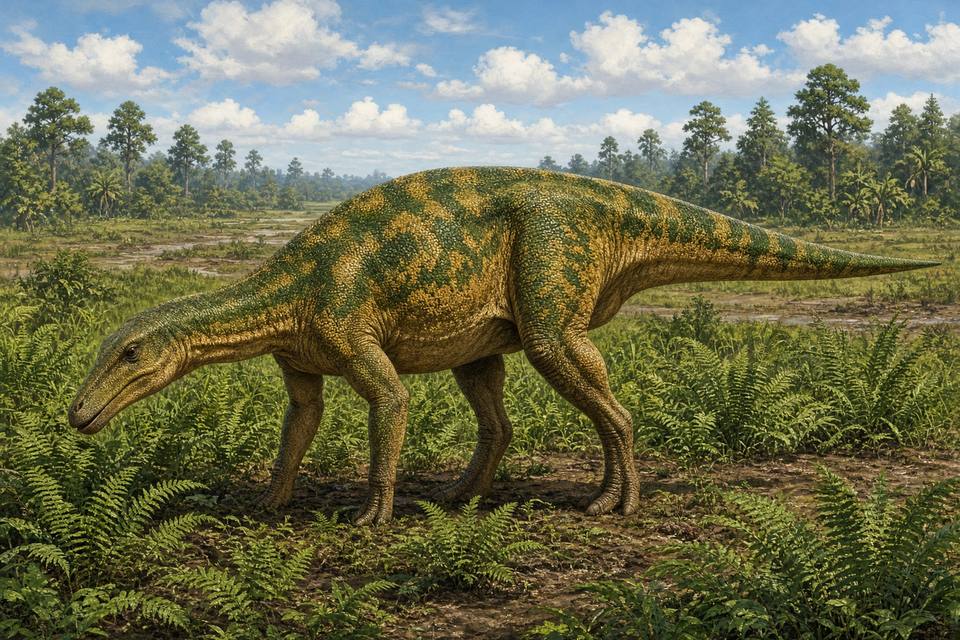
beaked plant-eater
Gobihadros
Say it like this: “GOH-bee-HAD-ros”
Gobihadros mongoliensis
Gobihadros ate plants and walked on two or four legs. It lived in the Late Cretaceous. Bones have been found in Mongolia.
- When
- Late Cretaceous (Cenomanian–Santonian) · roughly 100.5 to 83.6 million years ago
- Named in
- 2019 · Tsogtbaatar, K.; Weishampel, D. B.; Evans, D. C.; Watabe, M.
- Hip height
- 2.3 m · 8 ft
- Length
- 7.5 m · 25 ft
- Weight
- 2.6 tonnes
- Found in
- Mongolia · Bayanshiree
- Food and walking
- Herbivore · Two or four legs
- Kind
- beaked plant-eater · Ornithopod
- Family branch
- Hadrosauromorpha
The story in short
In 2019, K. Tsogtbaatar and colleagues published the name Gobihadros. The name means “gobi hadrosaur.”
Fossils referred to Gobihadros date to the Late Cretaceous (Cenomanian–Santonian), roughly 100.5 to 83.6 million years ago. Finds come from Mongolia, including the Bayanshiree Formation. It was a herbivore and could move on two or four legs.
Published estimates put Gobihadros at a length near 7.5 m, hips about 2.3 m high, and a body mass around 2.6 tonnes.
On the family tree it sits in Hadrosauromorpha, among the ornithopod dinosaurs.
Close relatives
Bactrosaurus
Bactrosaurus johnsoni
Late Cretaceous (Campanian) · roughly 83.6 to 72.2 million years ago
Claosaurus
Claosaurus agilis
Late Cretaceous (Coniacian · Santonian) · roughly 89.8 to 83.6 million years ago
Eolambia
Eolambia caroljonesa
Late Cretaceous (Cenomanian) · roughly 100.5 to 93.9 million years ago