Look up · dinosaur 615 of 1,425
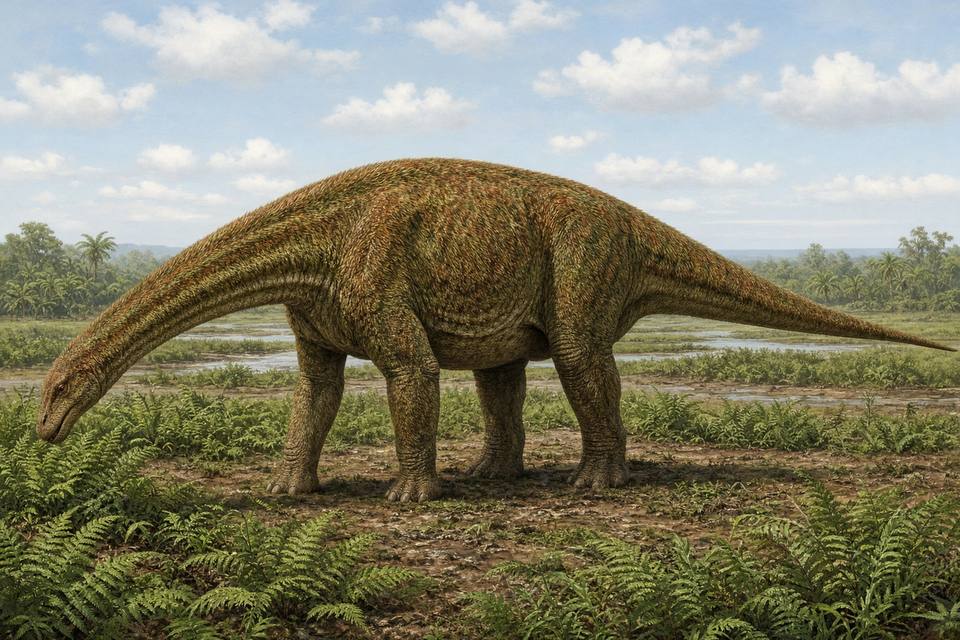
long-neck giant
Isisaurus
Say it like this: “iss-ee-sore-us”
Isisaurus colberti
Isisaurus ate plants and walked on four legs. It lived in the Late Cretaceous. Bones have been found in India.
- When
- Late Cretaceous (Maastrichtian) · roughly 72.2 to 66 million years ago
- Named in
- 1997 · Jain, S. L.; Bandyopadhyay, S.
- Hip height
- 2.2 m · 7 ft
- Length
- 18 m · 59 ft
- Weight
- 15 tonnes
- Found in
- India · Lameta
- Food and walking
- Herbivore · Four legs
- Kind
- long-neck giant · Sauropod
- Family branch
- Saltasauroidea
The story in short
The genus Isisaurus dates to 1997, the year S. L. Jain and S. Bandyopadhyay described it. The name means “iSI lizard.”
Fossils referred to Isisaurus date to the Late Cretaceous (Maastrichtian), roughly 72.2 to 66 million years ago. Finds come from India, including the Lameta Formation. It was a herbivore and walked on four legs.
Published estimates put Isisaurus at a length near 18 m, hips about 2.2 m high, and a body mass around 15 tonnes.
On the family tree it sits in Saltasauroidea, among the sauropod dinosaurs.
Close relatives
Arackar
Arackar licanantay
Late Cretaceous (Campanian · Maastrichtian) · roughly 83.6 to 66 million years ago
Bustingorrytitan
Bustingorrytitan shiva
Late Cretaceous (Cenomanian) · roughly 100.5 to 93.9 million years ago
Mansourasaurus
Mansourasaurus shahinae
Late Cretaceous (Campanian) · roughly 83.6 to 72.2 million years ago