Look up · dinosaur 517 of 1,425
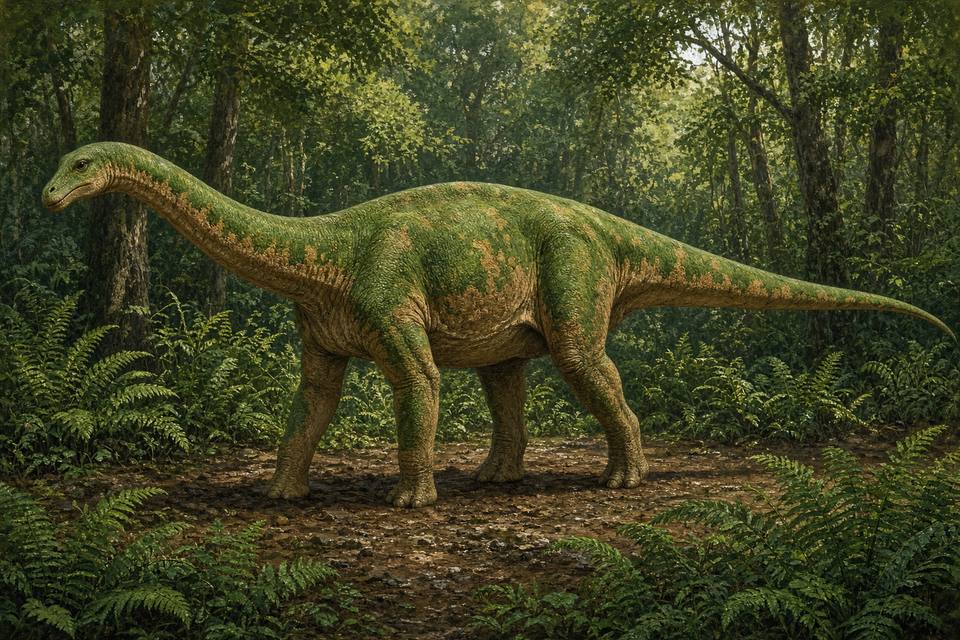
long-neck giant
Gondwanatitan
Say it like this: “gon-DWAHN-uh-TIE-tuhn”
Gondwanatitan faustoi
Gondwanatitan ate plants and walked on four legs. It lived in the Late Cretaceous. Bones have been found in Brazil.
- When
- Late Cretaceous (Campanian · Maastrichtian) · roughly 83.6 to 66 million years ago
- Named in
- 1999 · Kellner, A. W. A.; Azevedo, S. A. K. D.
- Hip height
- 1.4 m · 5 ft
- Length
- 7 m · 23 ft
- Weight
- 1 tonnes
- Found in
- Brazil · Adamantina
- Food and walking
- Herbivore · Four legs
- Kind
- long-neck giant · Sauropod
- Family branch
- Aeolosaurini
The story in short
The genus Gondwanatitan dates to 1999, the year A. W. A. Kellner and S. A. K. D. Azevedo described it. The name honors a person tied to the fossil or its study.
It lived in the Late Cretaceous (Campanian · Maastrichtian), roughly 83.6 to 66 million years ago. Finds come from Brazil, including the Adamantina Formation. It was a herbivore and walked on four legs.
Published estimates put Gondwanatitan at a length near 7 m, hips about 1.4 m high, and a body mass around 1 tonnes.
On the family tree it sits in Aeolosaurini, among the sauropod dinosaurs.
Close relatives
Adamantisaurus
Adamantisaurus mezzalirai
Late Cretaceous (Campanian · Maastrichtian) · roughly 83.6 to 66 million years ago
Aeolosaurus
Aeolosaurus rionegrinus
Late Cretaceous (Campanian · Maastrichtian) · roughly 83.6 to 66 million years ago
Arrudatitan
Arrudatitan maximus
Late Cretaceous (Campanian · Maastrichtian) · roughly 83.6 to 66 million years ago